Hello everyone! I’m taking a short mid-year break right now to recharge, not do much work / game dev, and focus on leisure and relaxation for a little while, as well as catching up some larger but less “urgent” life admin / life jobs that need doing but can be hard to find the time and attention for when working on everyday stuff with a lot of focus. As such, there’s no devlog this fortnight, but people seemed to enjoy last year’s interlude post and its discussion of some of the early PCG experiences / gameplay mechanics I’d encountered in games (and how they were influencing URR), so I thought I’d write a kind of companion piece this time about some of the cryptic riddle quests I’ve encountered in games I’ve played recently – or rather, in one game, specifically Blasphemous II. Although primarily a Metroidvania (and a really good one) it, like some other Metroidvania-y titles – such as Environmental Station Alpha, and Tunic, for example – has some really interesting cryptic late-game stuff which is optional to the core quest, but really tests your brainpower. These range from “this is mostly great but could have been a little more polished” to “this one really didn’t work, even if I like the concept” – and I found myself thinking a lot about these as I played them, and what I could learn from them. The more I think about this kind of gameplay, the more I think I’m zeroing in on a sense of what works and what doesn’t – and why – and I wanted to share some of these thoughts, and what they mean for my design of Ultima Ratio Regum. This entry has spoilers for obscure late-game quests in Blasphemous II and mid-game and late-game quests La-Mulana, but if that doesn’t bother you, read on – and let me know your thoughts!
Symbols Quest
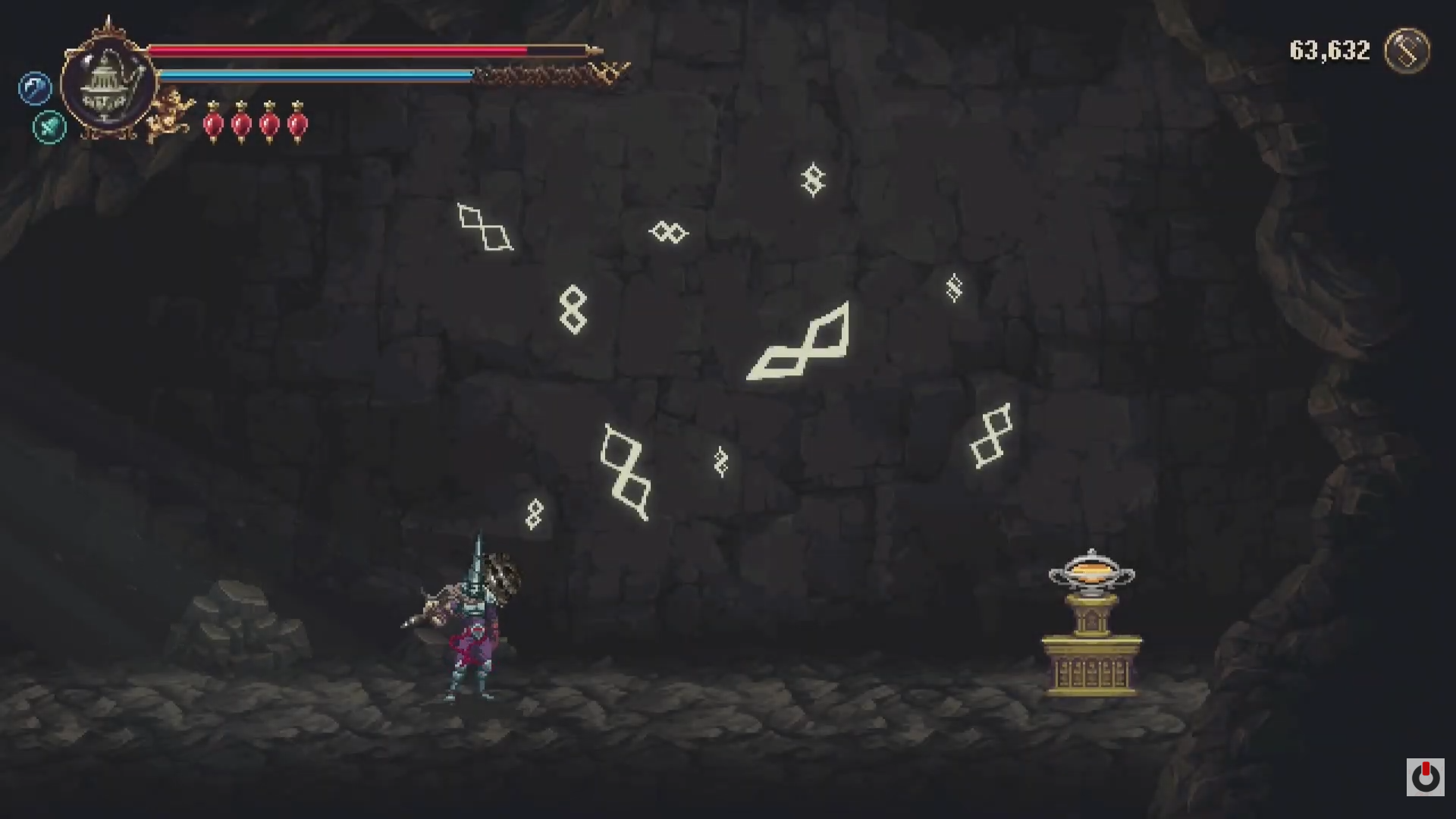
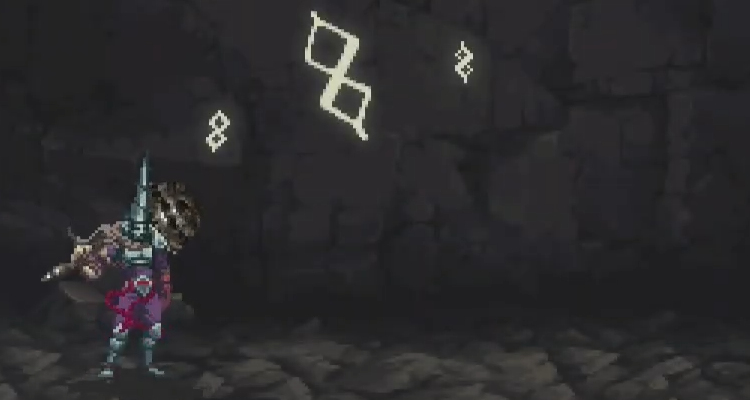
The first quest is found in a mysterious room that one can access from pretty early in the game. When you first get in there, none of the symbols shown in the screenshot above are lit up. Instead they are simply etched into the background wall of this chamber – and this is the symbol that Blasphemous uses in its branding and on plenty of in-game stuff as well. The room screams “there is a secret here!” but there isn’t much to tell you what it might be, except that in this room you collect a magical power which enables you to ring a phantom bell, which – according to the item description – was once used “in the presence of its symbol”. Those are all the hints you’re going to get, actually, about an incredibly hard cryptic late-game quest, and certainly the weakest of the bunch in my opinion (I’m going to start with this, the most problematic, then move to one I think is mostly very strong but has a few issues, and then conclude with one I think is entirely excellent except for one, very minor issue). Nothing, of course, appears to tell you that such a quest exists – one is only given this item, talking about tolling it in the presence of a symbol, in a room that makes it pretty clear what the symbol in question is. What one is supposed to decipher from this, though it’s a bit tricky, is to go and seek out this symbol around the world map, and then when you find copies of the symbol, use this bell spell (as it were) to activate the symbol, which makes it glow both where found and on the wall of your cave. Once you’ve found them all, you get an achievement and a lot of in-game currency, too. In principle I think this is much more interesting than a standard collect-a-thon quest, especially since it’s hard to work out what it even wants you to actually do, but unfortunately I just don’t think this particular quest really comes together as a cryptic riddle quest.
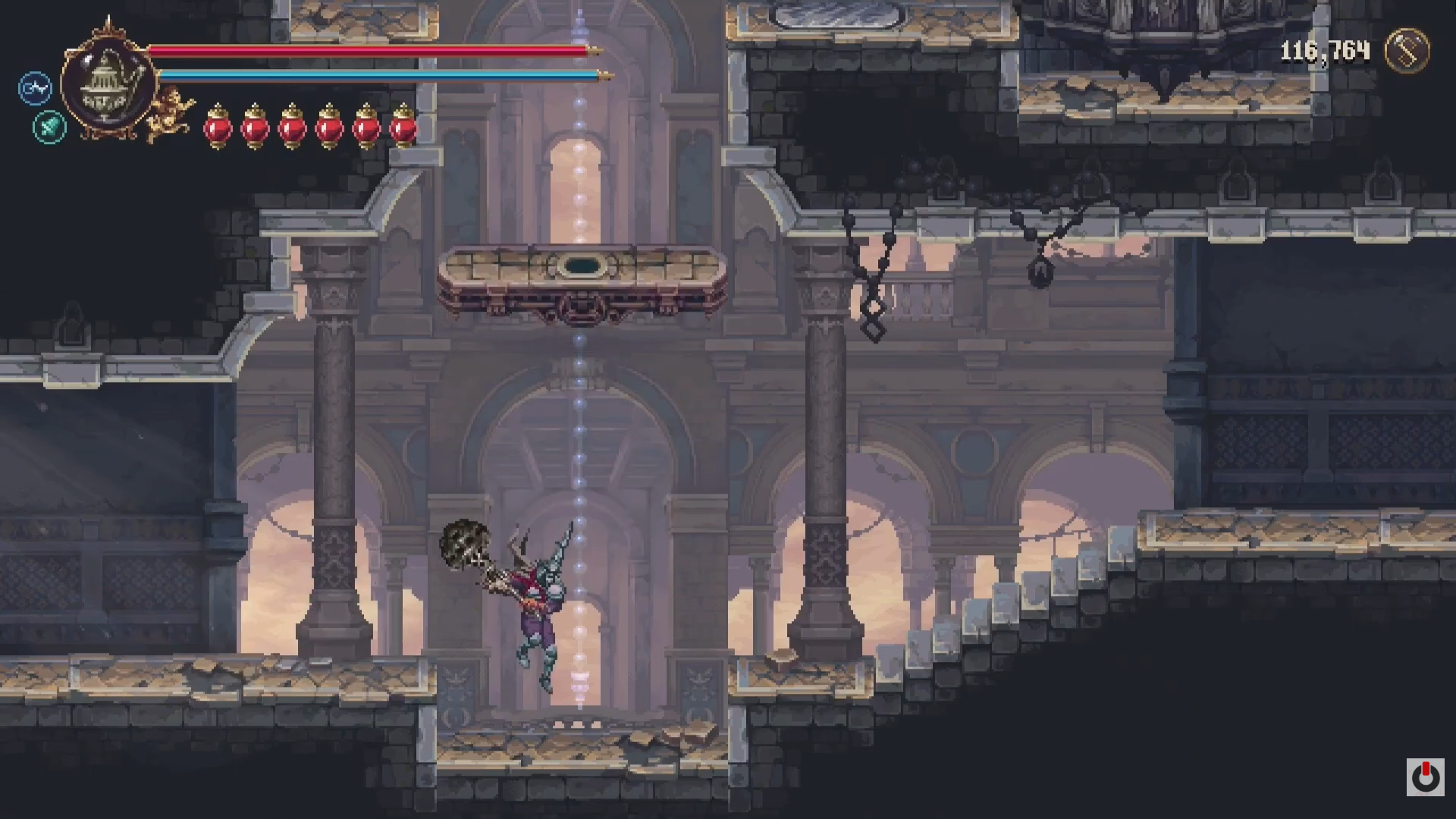
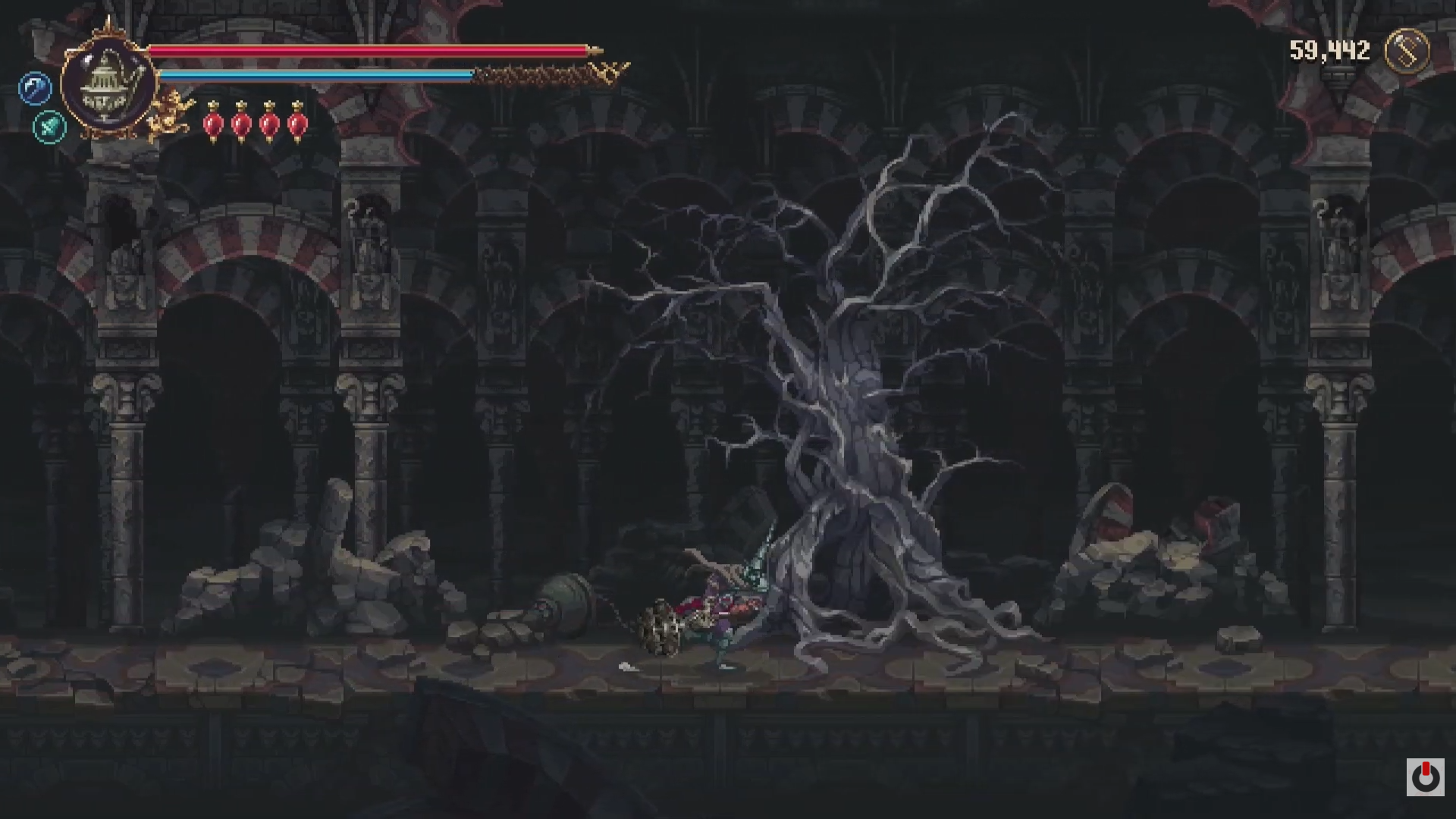
The problem arises from the fact that finding these symbols in the game world is… essentially impossible. One or two of them are quite prominent and I quickly got those, but the rest could be hidden in any map grid in the entire game world, and we are talking perhaps five hundred of those if not, actually, significantly more – I haven’t counted. Many of them are actually hard to see even if you’re on the right screen! Alternatively, if the player was meant to notice these on their first playthrough and take note of them for future use, that’s… well, it’s optimistic at best. I’m sure you can see where the symbol is hidden in the above image because we know it’s there, but noticing this when just moving through the area is bordering on the impossible. I’m achingly meticulous in Metroidvania games, especially those which I know have interesting end-game quests or riddles, precisely because I know nothing will be accidental and I need to take mental (and sometimes actual) notes on anything even remotely erroneous I come across in the main game, because it might be important merit returning to later. Yet, I didn’t see this, and just moving through the game – when you’re reading the terrain, enemies, platforms, and not looking at the incidental art – I’d suggest this is almost invisible until one knows to seek it out. Sure enough, I didn’t see nine of the ten of these symbols on my playthrough (the “first” one of them is very hard / sort of impossible to miss). Even more crazily, this one above is one of the more visible ones – some are essentially invisible unless your monitor brightness is turned up very high, some are so small that they’re barely more than a few pixels, and one of them is hidden behind a breakable generic object… that you would have no particular reason to break! And of course in a room with no defining features, and it’s a breakable object that has perhaps a hundred or two-hundred copies through the area it’s found in. That last one is particularly bonkers. I’m honestly impressed anyone ever found the blasted thing. I wouldn’t be shocked if the first person who found it actually found it by finding some efficient way to check in the game’s code – or simply by going through every single room, activating the spell, and just seeing what happens, without actually bothering to look at everything.
Can you even see the one here…?
The problem, then, is that it just doesn’t work as a quest. If they were expecting players to notice these on their playthrough, that would be wildly unlikely for some of them, and essentially impossible for others (some of which one can barely even see!). If they were not expecting players to notice these on their playthrough, but were expecting players to seek them out once they (somehow) figured out the nature of the hidden quest, I think they are far too well-hidden, often in places with no distinguishing features, and again, some are just so damned hard to see, and the map is far too large for this to be anything other than crushingly dull. If they were not expecting players to notice this on their playthrough, but were expecting players collectively to seek them out, that still doesn’t work brilliantly for the reasons above – there’s no exhaustive way to do this except searching the entire map and using the bell on every screen to see whether it does anything or not. As such, I’m honestly not sure what the developers actually had in mind here. What’s the intended solve path on this quest? None of them seem especially sensible. I think the idea of this quest is a genuinely neat one, but there needed to be some way to logically tackle it. Perhaps the symbols could only appear in important places, or only in places that shared something in common, or perhaps a map could point towards the sort of areas to look in (and have a penalty for just randomly ringing the bell everywhere you go), or all the symbols could be known to be in one area of the map, or in certain sorts of rooms, or something like that. Maybe the best and cleverest option would be to place them all in dead-ends with no other use (see discussion of this below) in which case I, at least, and I’m sure others, would have registered these as strange places to pay attention to. In turn, a common pitfall of the cryptic riddle is allowing for infinite guesses. This is the problem with the final – deranged – puzzle in La-Mulana, because once you understand that you need to activate a given item in a given room in each area, and each area only has twenty rooms… you can just go through them and try it in every room, even if you have no understanding of why the correct room is correct! This is pretty similar, though on a larger scale, but hits the same problems for the same reason. URR will, of course, avoid these problems through the size of the world map (no way to realistically try everywhere), the procedural generation of quests (no way to crowdsource), and the specificity of the clues given (no ambiguity on what you should do once you’ve cracked it) – and I think that’ll be a potent combination. Nevertheless, this is an interesting quest and in the abstract I love the concept, but I think hits some real pitfalls that are going to prevent almost any player from not simply looking the thing up.
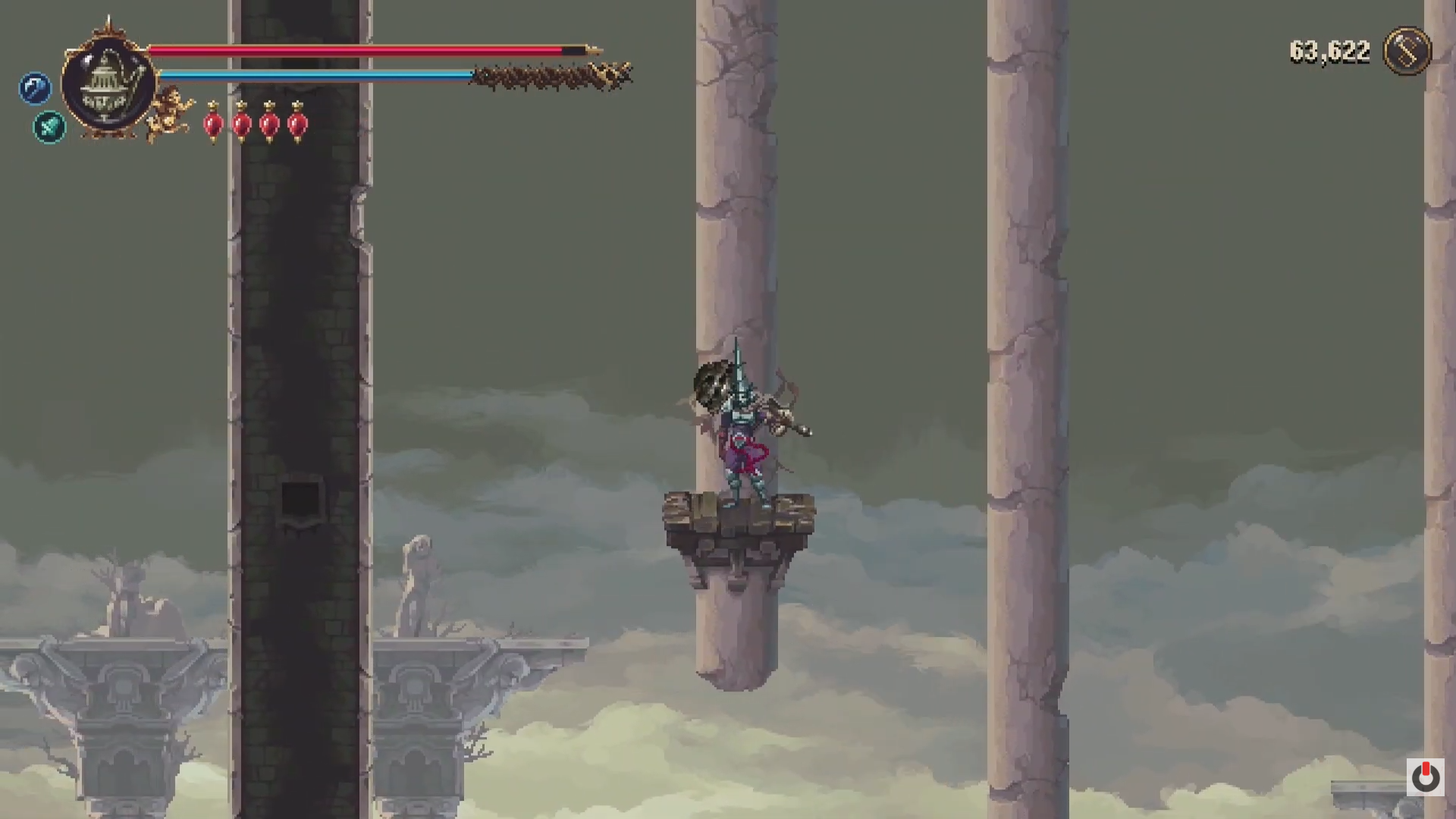
Can you even see the one HERE…?
So: what will I be doing with this in URR, therefore? Well, in general in cryptic riddles games, and games with cryptic riddles in them, challenging the player’s observation is a really core and essential tool. And, importantly, a fun one as well – in a well-designed quest of this sort, there’s something intensely satisfying about spotting it – whatever “it” might be. It’s really gratifying to notice that one thing is unlike everything else, or that some things form a shape that’s hard to see, or that there’s some kind of relationship between thing X and thing Y that isn’t instantly visually obvious but is undeniably there, or simply to be looking at something or reading and something and instantly notice something in the text that isn’t in any way highlighted or brought to the fore, but which you think has importance. I can think of examples of this sort of puzzle in many games of this sort (e.g. The Outer Wilds, Tunic, etc), and I think it’s a fantastic tool for rewarding the player really paying attention, and in turn encouraging the player to keep paying attention, precisely because they’ve now learned the level of focus the game expects from them. As such, I think there are some really interesting variations of this idea URR would do very well with – perhaps one of many statues of a god is holding something different, for example – but they need to be coupled with other information so the player isn’t just tediously looking at every single one until they find it. Being told there is something to find it one piece of information, but having another riddle tell you which religious building its in, for instance, limits the scope nicely (while still requiring decipherment) and gives the player a satisfying moment of finding the unique statue, and doing with it whatever it is that one should do. Or, alternatively, being told early on to look out for something different also works really nicely – e.g. before you’ve ever been in a castle, you’re told to look out for a castle where X is different. You can’t know whether the first castle is that castle, since you’ve only seen one; once you’ve seen two, if you know X varies across them, then you know it’s one of those, and a third will answer which it is; and then from the third onwards, if you haven’t yet seen a different X, you’ll know as soon as you do that that’s the castle in question. While I think this particular quest is just far too frustrating for any one person to solve – although, was it perhaps meant to be a community effort…? – observation, as a whole, is a wonderful thing to play with in cryptic riddle type games.
Cursed Letters Quest
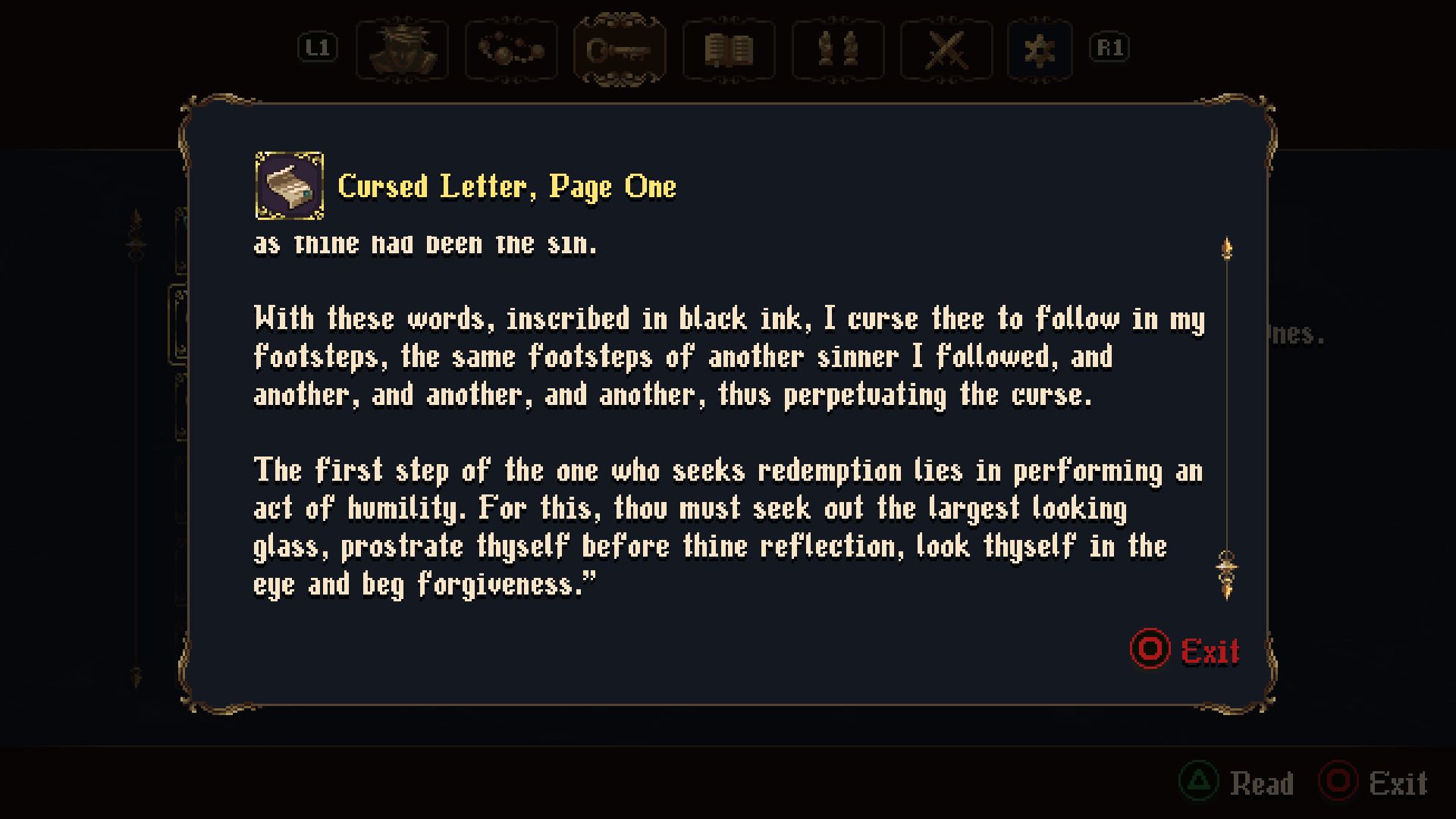
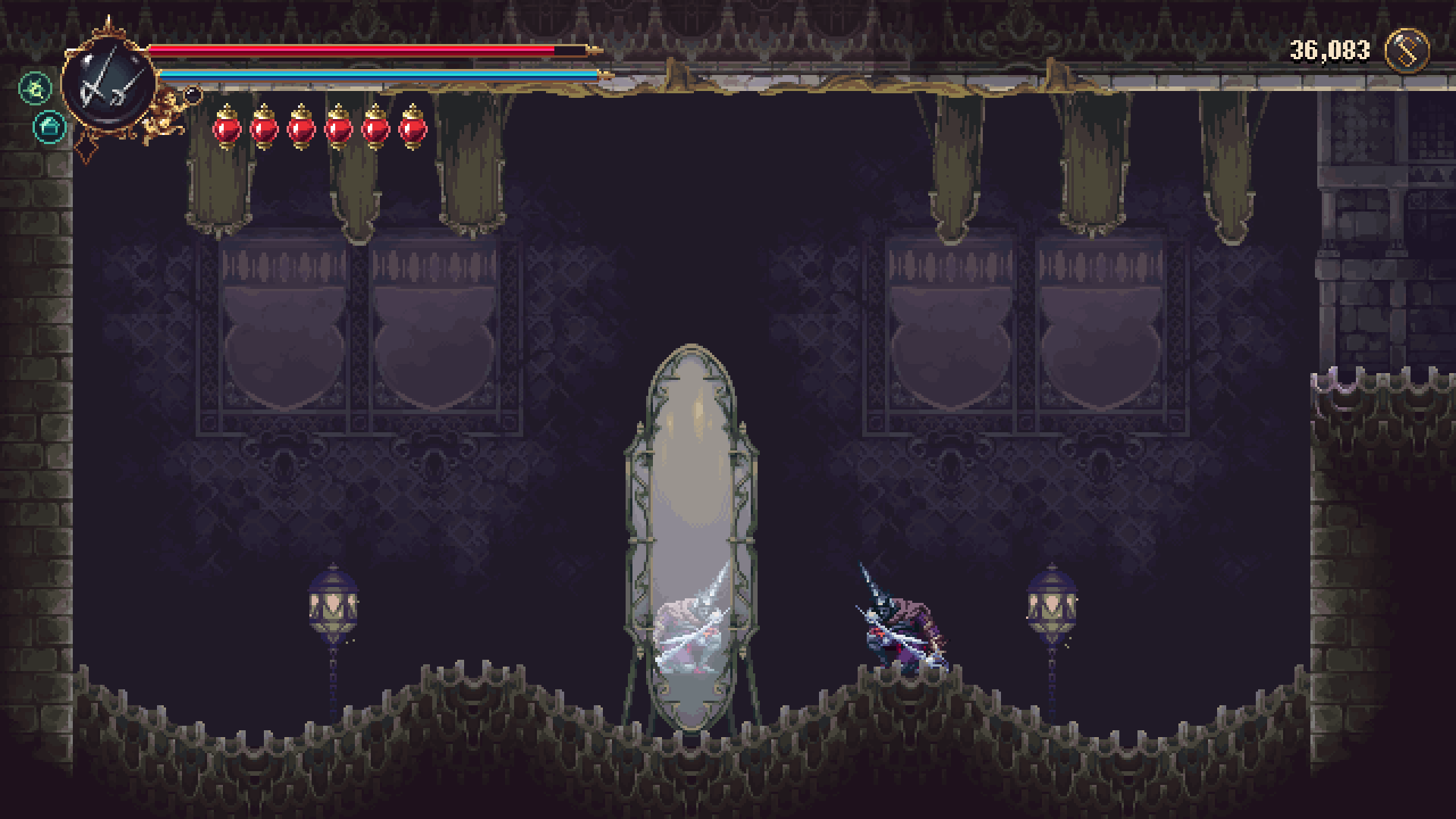
The next riddle-type quest I thought was much stronger, though one segment of it definitely had an issue. In this one the player finds a letter that cryptically describes a place in the game world, and something you should do there – hmm, this sounds familiar! That’s always a really good pairing for a cryptic riddle in a game, since it can’t possibly be brute-forced (any remotely large game world will have a near-infinite number of places you could stand, and many things you might do there, e.g. change weapon, jump, stand still, crouch, move back and forth several times, open your inventory, drop an item, or whatever it might be) and there’s a huge satisfaction for the player in figuring out where exactly it wants you to go. I confess that when I got this first part of this quest I was really very excited by it. All my time spent playing these sorts of games has – I flatter myself – made me very observant indeed when it comes to remembering areas of the game world which perhaps had something unusual that didn’t seem at first glance to have an obvious purpose, and I was keen to see whether or not I’d be able to crack this one. The first, as you’ll see above, was definitely the easiest of the bunch, and I immediately knew where to go here. In an area filled with mirrors I’d previously noticed that there was one mirror which was larger than all the others, couldn’t be broken, and had an entire room to itself! All that kind of stuff obviously screams “there’s something to do here” to any player who exhibits even a modicum of sentience, and honestly I’d half been waiting to be told to do something in this room when the time came. I actually like this idea for URR, as well, of sometimes spawning really unusual rooms in buildings, or really unusual outside structures in towns or cities, which don’t seem to have any initial purpose, but which are so highly distinct from everything else that the player who encounters them should immediately know there’s something to do here, and store it away for future use. Anyway, this first one was easy – I got to the mirror, positioned myself so I appeared in the mirror, crouched, and sure enough the second clue immediately found its way into my inventory.
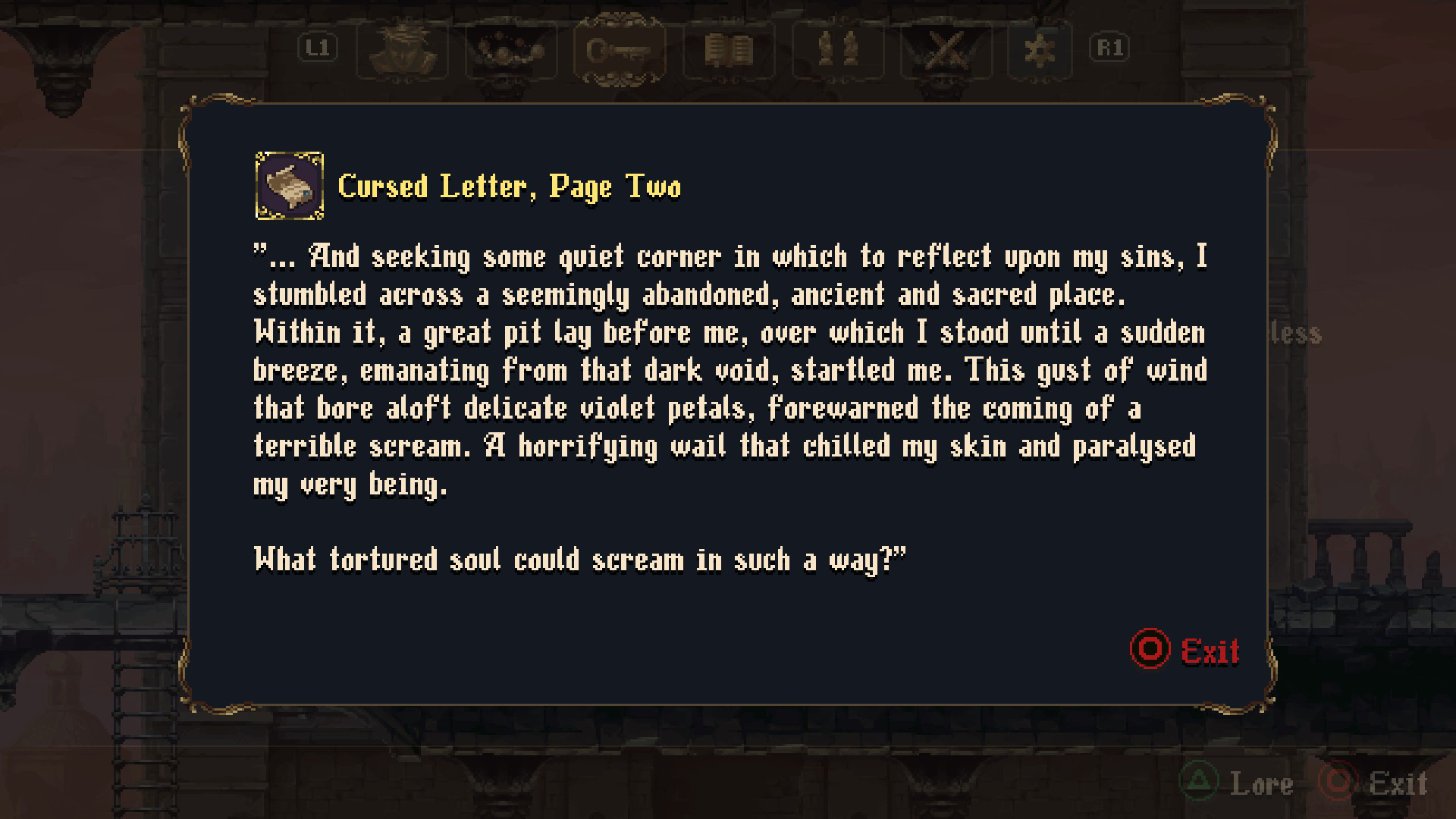
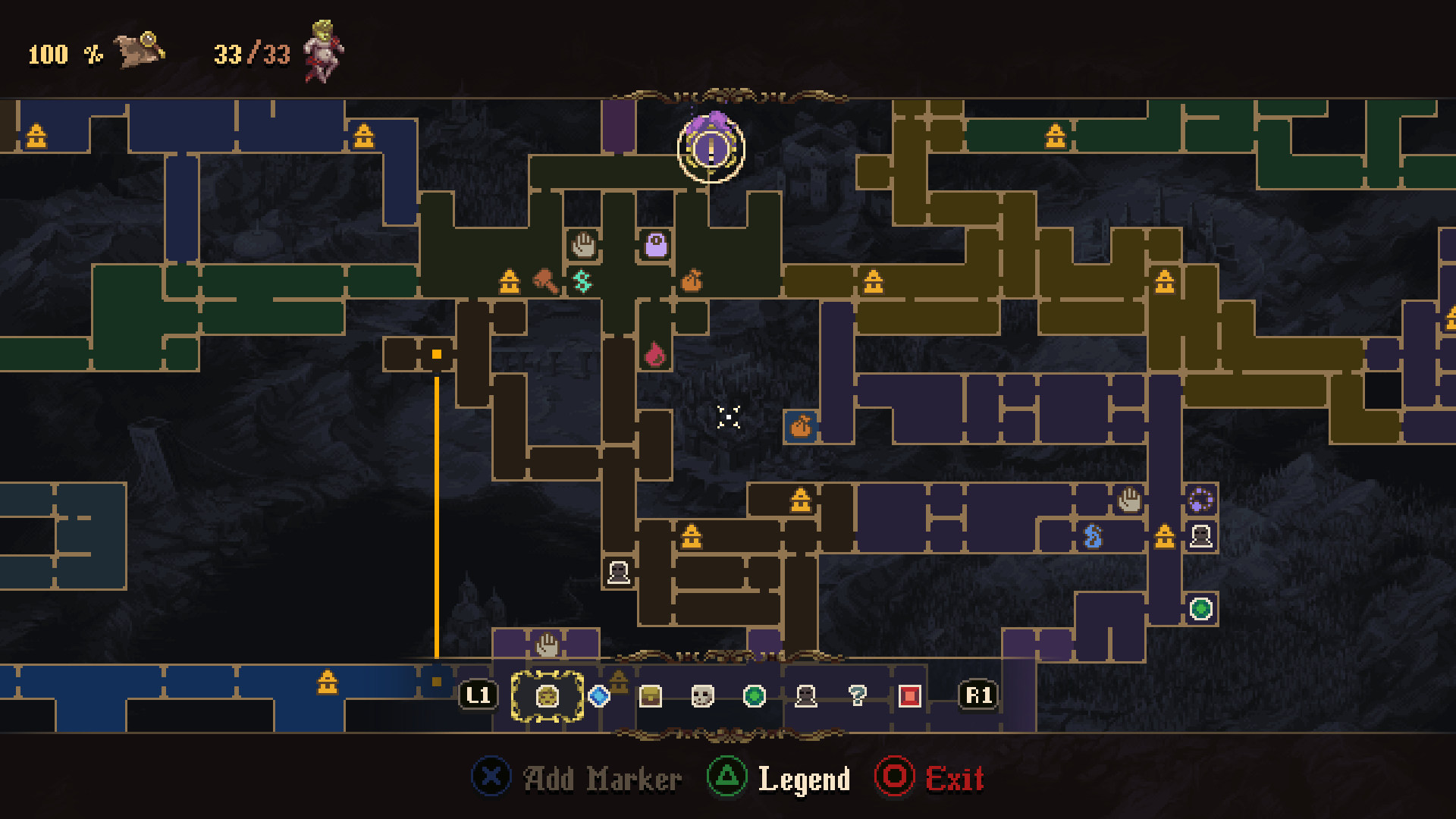
This second one was a little bit trickier. The world map for Blasphemous, as with its precursor, is rather large. There are certainly hundreds of different rooms that this could have been referring to, though inevitably it seemed unlikely to be a strongly horizontal area. This limited it immediately to parts of the game world where there were large stacks of rooms atop each other – the “great pit” seemed to imply something of significant size and probably not just a single map tile (as it were) – but it was the violet petals comment which proved the most useful hint. There is, indeed, a large vertical area roughly in the middle of the map, and at its bottom is some kind of very strange and unfortunate individual with a large number of excess arms, who is also growing out of (or being grown out of by?) some kind of vine or creeper with purple flowers. It’s a really distinct visual image, and an area where a pretty unique mini-quest plays out, so I was extremely confident I had the right column (shown roughly in the middle of the below image, the long dark brown column of terrain a few tiles to the left of the crosshair). What made this part tricky, however, is that the great pit in question has a number of possible locations going up it which could reasonably as the “top” of the great pit, which is what the above written clue certainly seems to be pointing towards. I’d say there are well over a dozen levels in the pit, and which one would logically count as the top one is honestly a bit unclear and certainly open to subjective interpretation. The “over which I stood” part of the clue does imply the top, but… which bit is the top? This is the sort of clue information that I have pretty mixed feelings about in cryptic riddle games, since while it’s far from frustrating to just ascend the pit and try each location for a few seconds by standing still (which I assumed to be the completion trigger), I think it’s perhaps a little inelegant. The pit could have had fewer layers that could have been understood as the “top” – and indeed which parts of this column would count as the “pit” was also unclear – but in the end I got up to near the top, and waiting there did indeed yield the third clue. This one wasn’t quite as strong as the first one, I felt, but still satisfying to ponder and decipher.
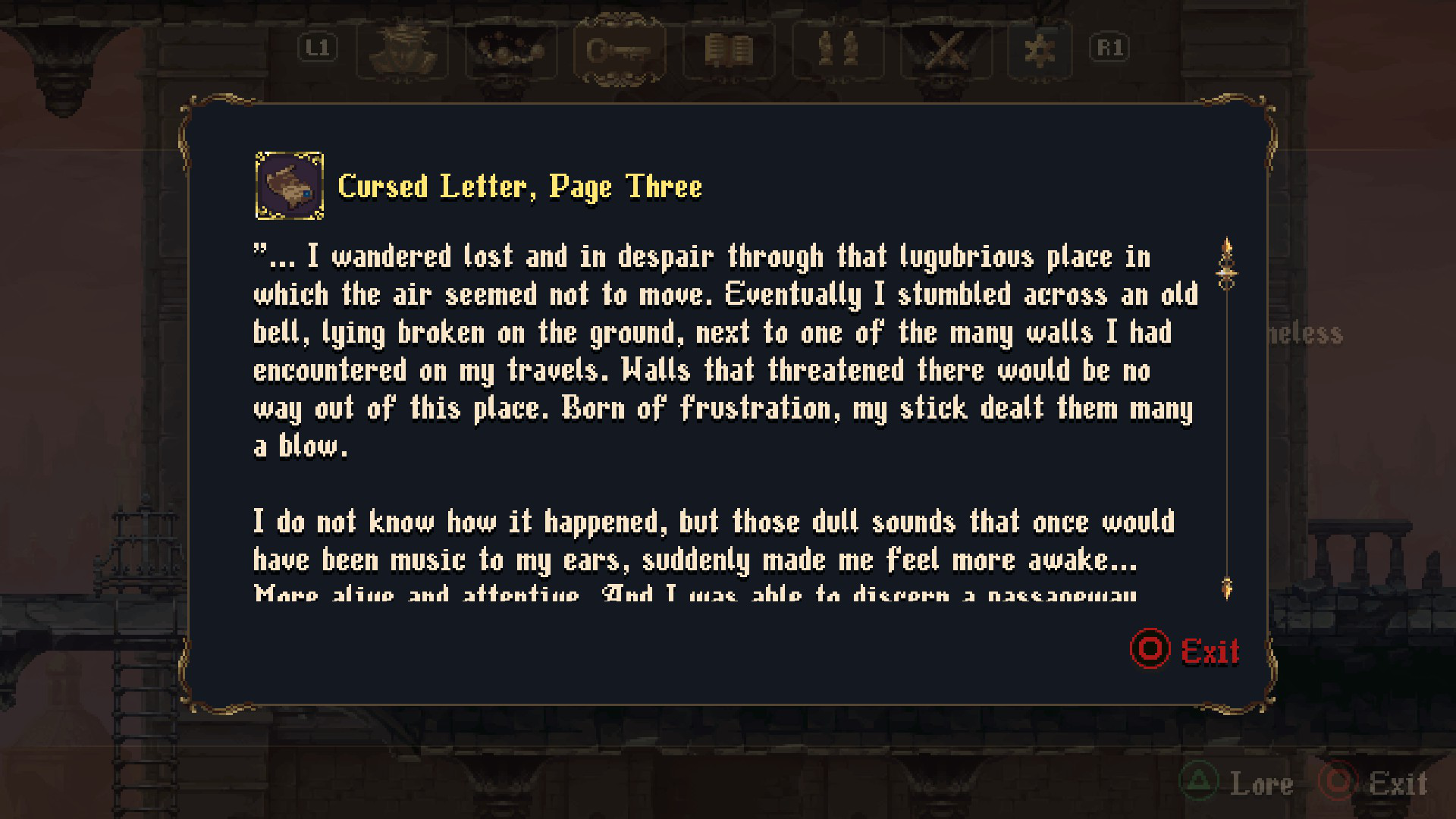
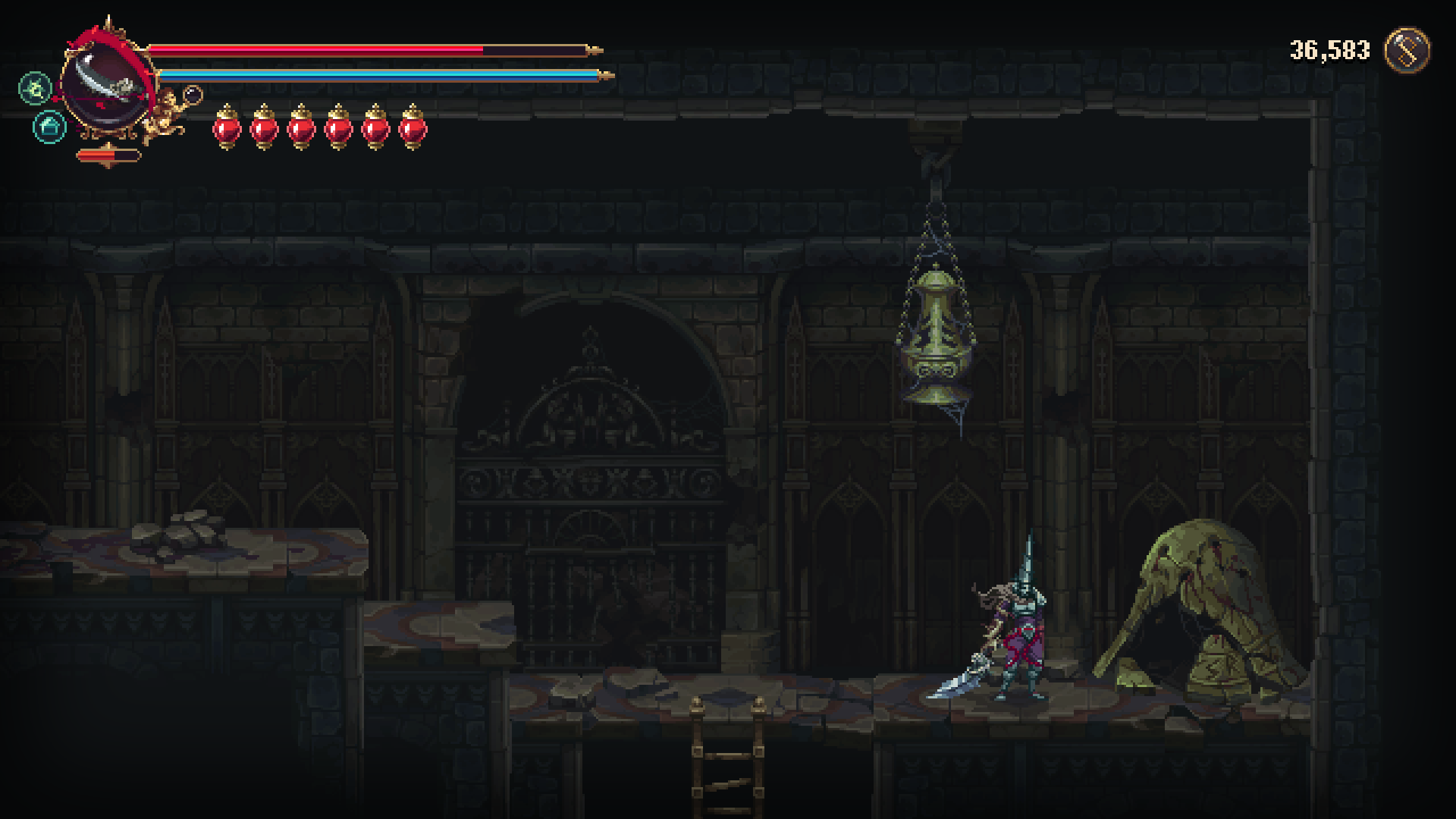
Now this one. We need to talk about this one. So, the clue is talking about seeking out a bell on the ground, which you could hit (at least, that’s how I interpreted the first paragraph). The first line of the second, to me, suggests that hitting this bell would ordinarily achieve nothing, but now it would (the rest of the text is missing from this screenshot) reveal a new passage behind the wall the bell is in front of. Blasphemous I and II both contain an enemy type which is essentially a person inside a giant human-sized bell, who is “inactive” until you get close to them. Once you are near, however, they wake up and get to their feet, and charge you, rushing headfirst into walls with a resounding clang. They deal a lot of damage, function as relatively tough early-game enemies until you get a very reliable way to dodge and avoid them, and indeed they really do fit into the general weirdness of the enemy design in this game – what a bizarre and warped form of penance (or worship?) repeatedly concussing oneself inside a giant bell would surely be. However, these are enemies, and you attack them, and kill them – the above clue suggests one broken on the ground. Did that mean I had to maybe kill one of them before they got to their feet? Or that there was a particular bell-charger enemy which had to be slain? This seems unclear to me. Making this one trickier was the fact that this enemy was found in quite a wide area in this game, and so I first found myself wondering whether any other bell existed in the game which I had missed. Given the (warped) Catholic / Iberian setting of the game, there are a lot of places where one might imagine a bell existing, and so I really searched my brains for something I’d missed here. I couldn’t remember any bell and I felt that if only a single such structure was present in the game, it would trigger that “this is important” bit of my brain, and I would have recalled it. As such, in the end I went back to try all kinds of things with the bell enemies, though I wasn’t optimistic. I soon remembered that there were variants on their bells on the ground which were just destructible props, but again, there were loads of them and all of them crumbled when attacked. Ultimately, however, I discovered one prop bell which wasn’t destroyed when you attacked it. When I returned to this room it did trigger the slightest, slightest recall, of having been here ten hours earlier, noticed it wasn’t one you could destroy… and foolishly, I confess, I had thought nothing of it! Yet it was this special bell, unlike all the other bells, which had to be struck, and which did indeed reveal the passage forward and the next clue.
Before we get to that clue, however… I want to interrogate this puzzle a bit. I think it hits a lot of really positive notes – it demands observation and memory, it wants you to notice and make a mental note of something unusual and distinct, and the clue is suitably subtle and works well. It does, however, have four issues, I think, and we can see these by looking at a comparable puzzle in La-Mulana – and probably my favourite puzzle in the entire game. That game world is full of destructible objects, things like pots and the like, which – as in many games – respawn when you leave a room and then later return to it. The world map is huge, but the player soon learns that pots will only drop an item the first time you break them. Some of them contain quite good drops, but most of the pots are only going to yield benefits the first time around, which is presumably to discourage farming and the like. In one area the player is given a clue which encourages the player character to show the “courage” to “search on bended knee for a single fallen item”. The solution to the puzzle – and again, spoilers, for a brilliant puzzle – is that there is a single pot in the entire game, in that area of the game where the clue is found, which always drops a single item every item it is broken, rather than dropping something first time and then dropping nothing ever again. It is subtle, almost extraordinarily so, especially since the player in that game spends so much of their time exploring and backtracking and searching in all kinds of places and breaking pot after pot after pot just in their ordinary traversal of the game world… but it can, actually, be noticed. The act of noticing it is something of a foundational moment in one’s play of the game where one has this moment of “my god, the game is this cunning?”, or perhaps “my god, the game expects me to pay this much attention?”. For the puzzle to work, though, it is contingent on the player having learned a lesson – this game is smart enough that I need to be paying attention to everything, and the developer would not have done this with no reason. It’s not a lesson we actually learn much in games, even clever ones, and unfortunately Blasphemous II hadn’t entirely taught me it by this point. I knew it was clever and sly; I didn’t know it was exhibiting those traits to that degree.
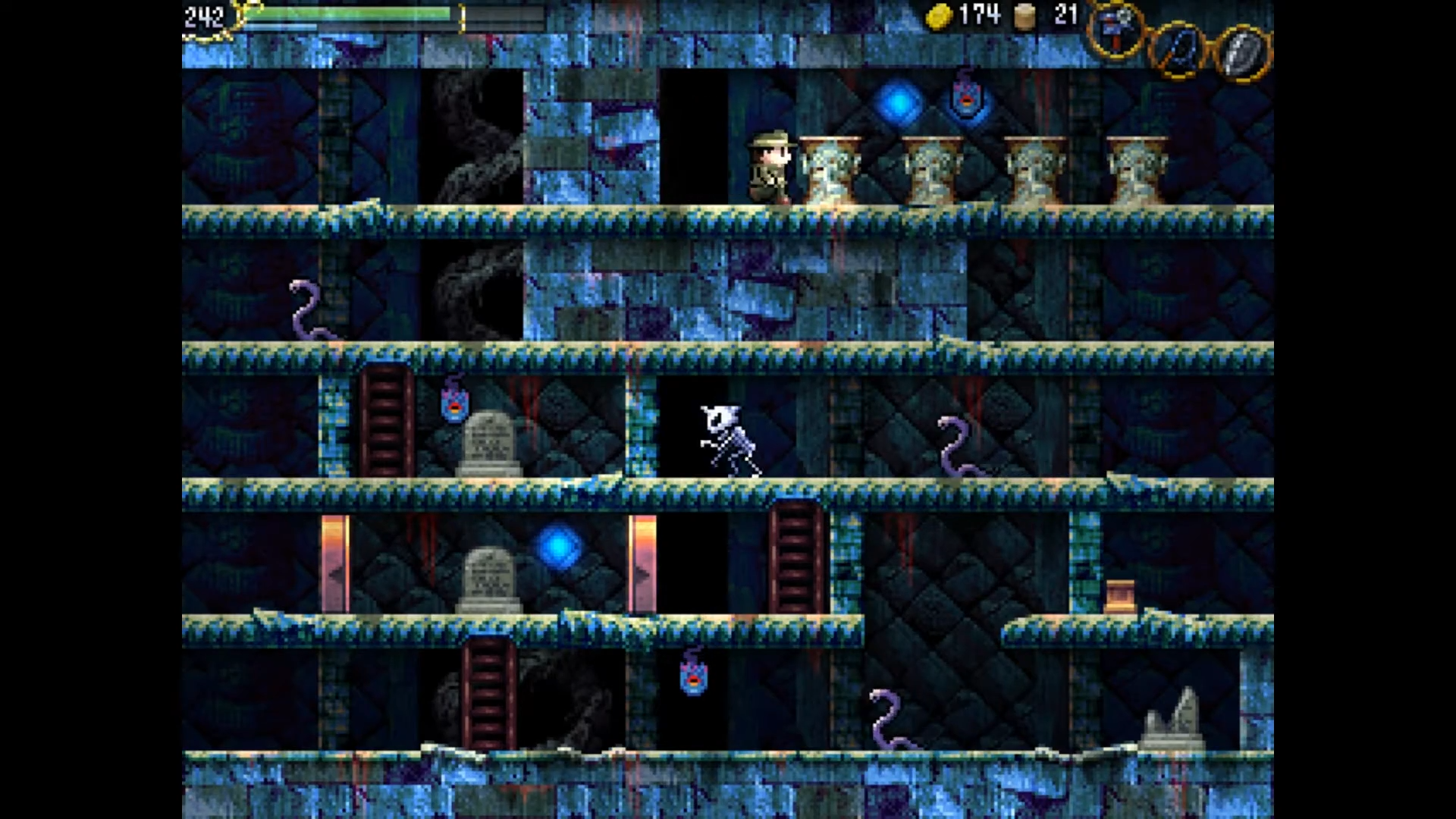
It’s therefore fascinating how closely connected these two quests are, and yet I think the La-Mulana one is a stroke of the utmost genius, while the third part of that quest I think just… doesn’t work. As above, I think there are four key differences here. Firstly, the La-Mulana one has the clue and the solution in the same area (a rarity in the game), which for this exact thing I think is really important. Blasphemous II places them in totally different zones. A puzzle of this type is already wildly difficult, wildly difficult, but having them in different areas of the game world? That’s, in my opinion, pushing this to extremes. I wonder whether La-Mulana put them in the same area because the designers felt it would just be too deranged otherwise? The more I reflect on it, the more I suspect that may well have been the case. Secondly, La-Mulana has the solution be essentially instantly accessible, if you can spot it; Blasphemous II gives you the clue to look for something unusual and different perhaps 10+ hours after you’ve visited the spot with the unusual thing (in L-M you will almost certainly discover this pot after being given the clue, rather than the other way around). Doing it in the opposite way around makes it much harder to register something distinctive (especially since, as I say, I wasn’t sure whether it was even distinctive, when I first encountered that bell). Thirdly, you’re probably paying far more attention to the pots in La-Mulana precisely because they can drop useful things than you will be to these background bell thingies in the other game, since those never yield anything of benefit. Fourthly, pots are pretty much the only breakable thing in La-Mulana, while in Blasphemous II there are so many little breakable objects all over the game world. This does add to the fun and detail of the game world and adds that bit of extra interest to battles when these things are destroyed… but also makes them all less noticeable. This is one of the hardest puzzles in all of La-Mulana, and this bell one is arguably even harder in Blasphemous, for all the reasons described above. I think this one is just too tricky, and there’s just not enough to even remotely point the player in that direction. I’m sure a few people got it, but I didn’t – yet I think there’s a lot to be learned here about the sequences of information given to the player, and the importance of teaching the player that nothing in the game world, absolutely nothing, is an accident.
Anyway – with all that done, we got the next clues.
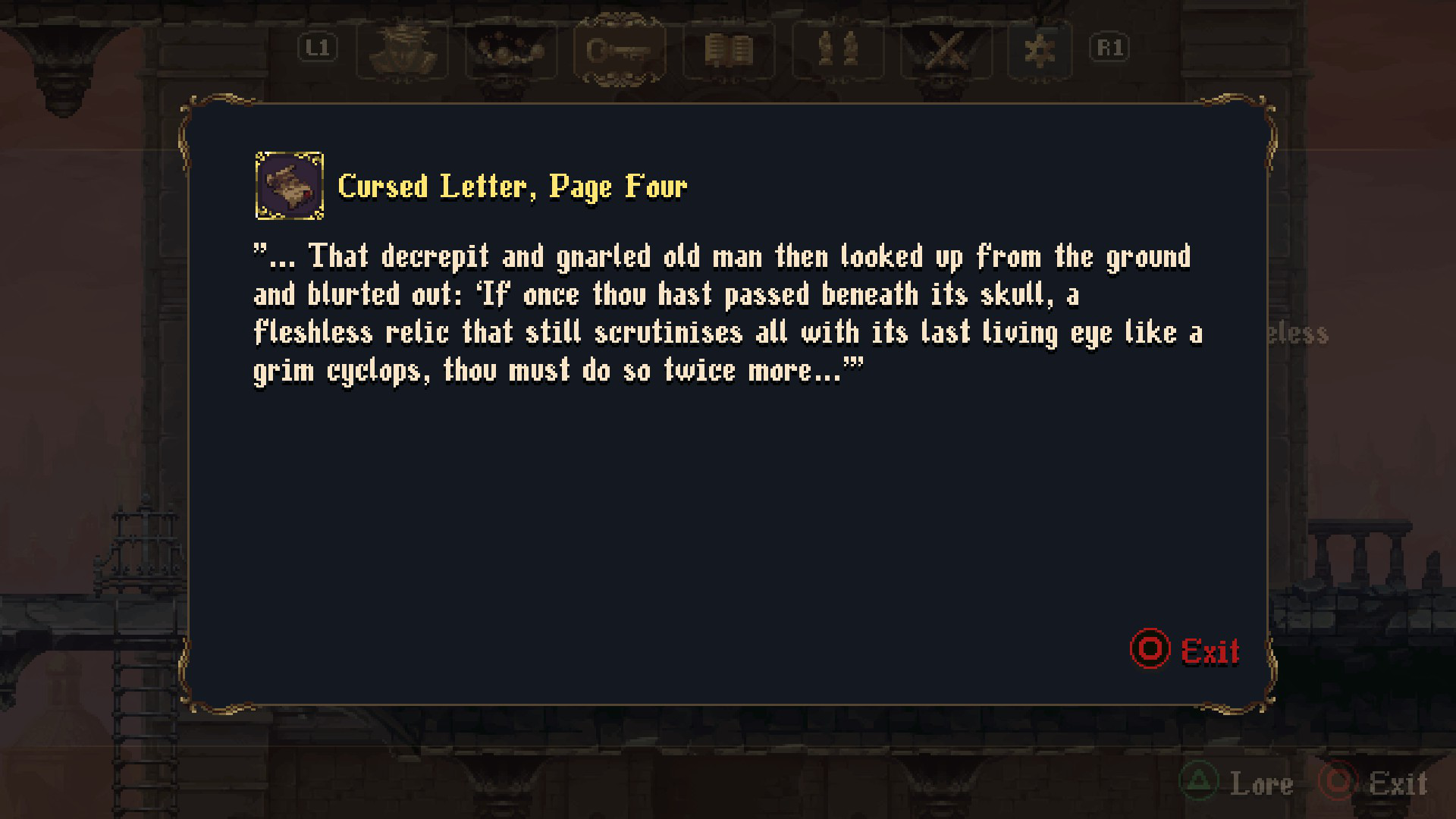
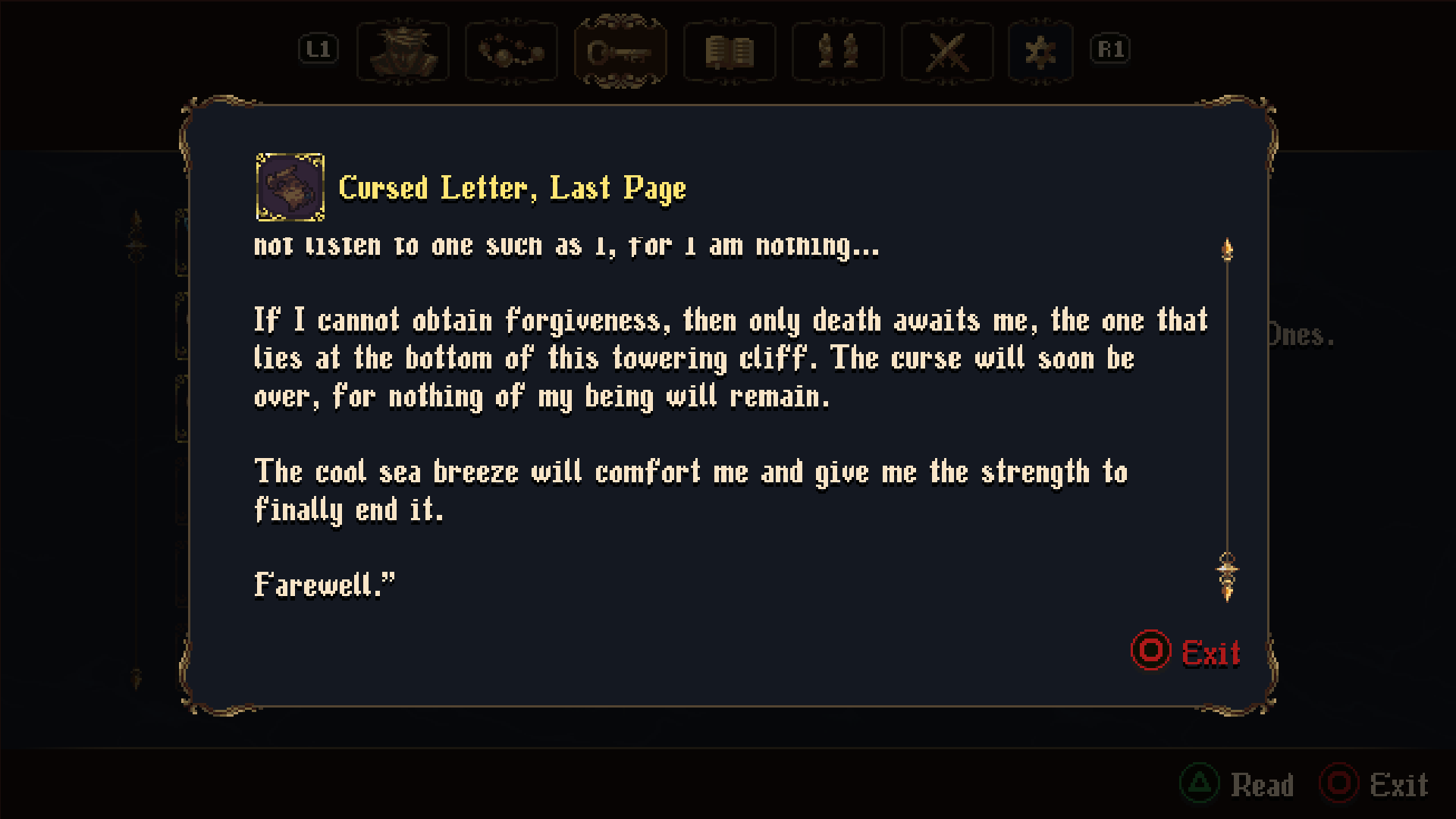
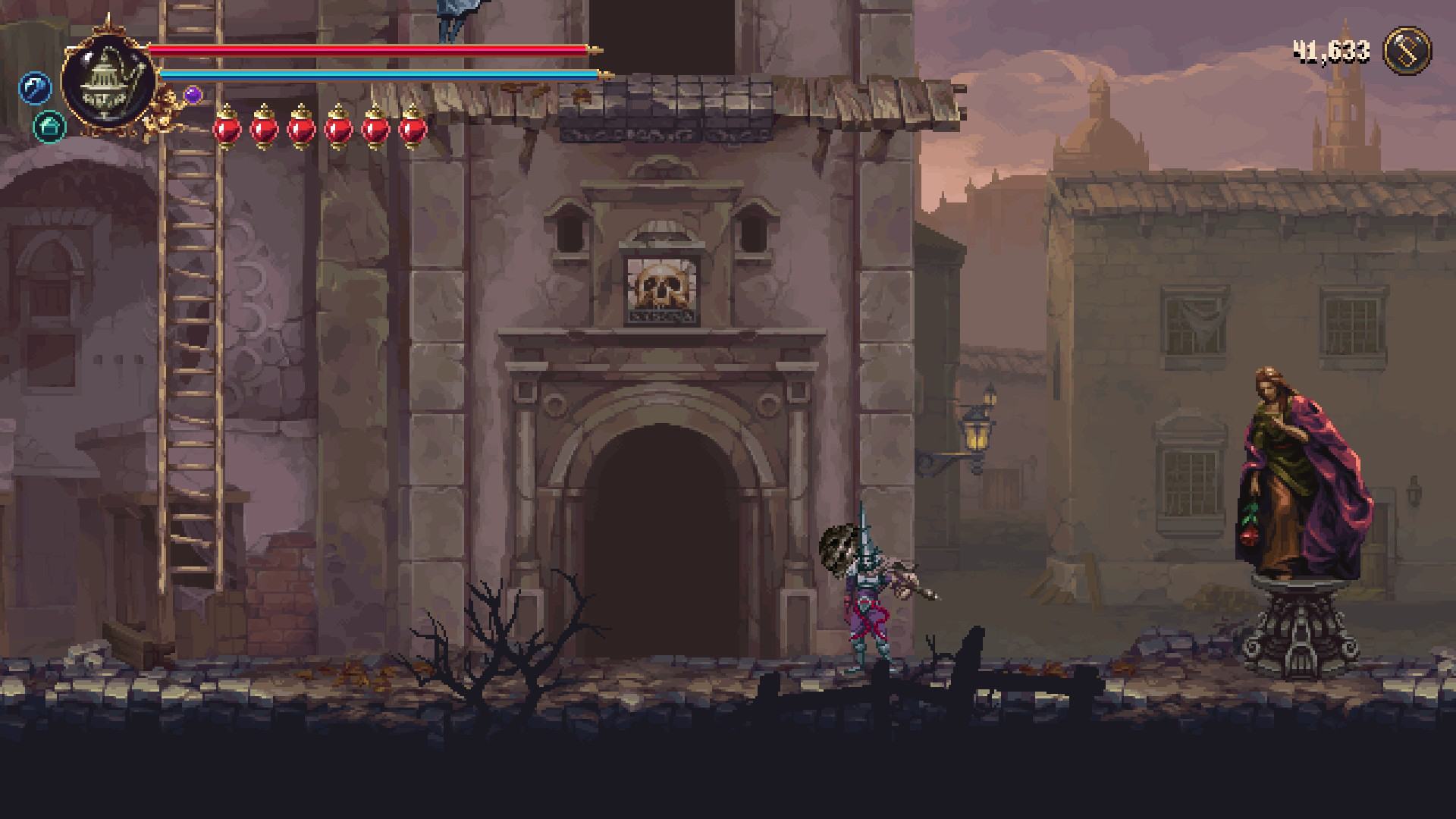
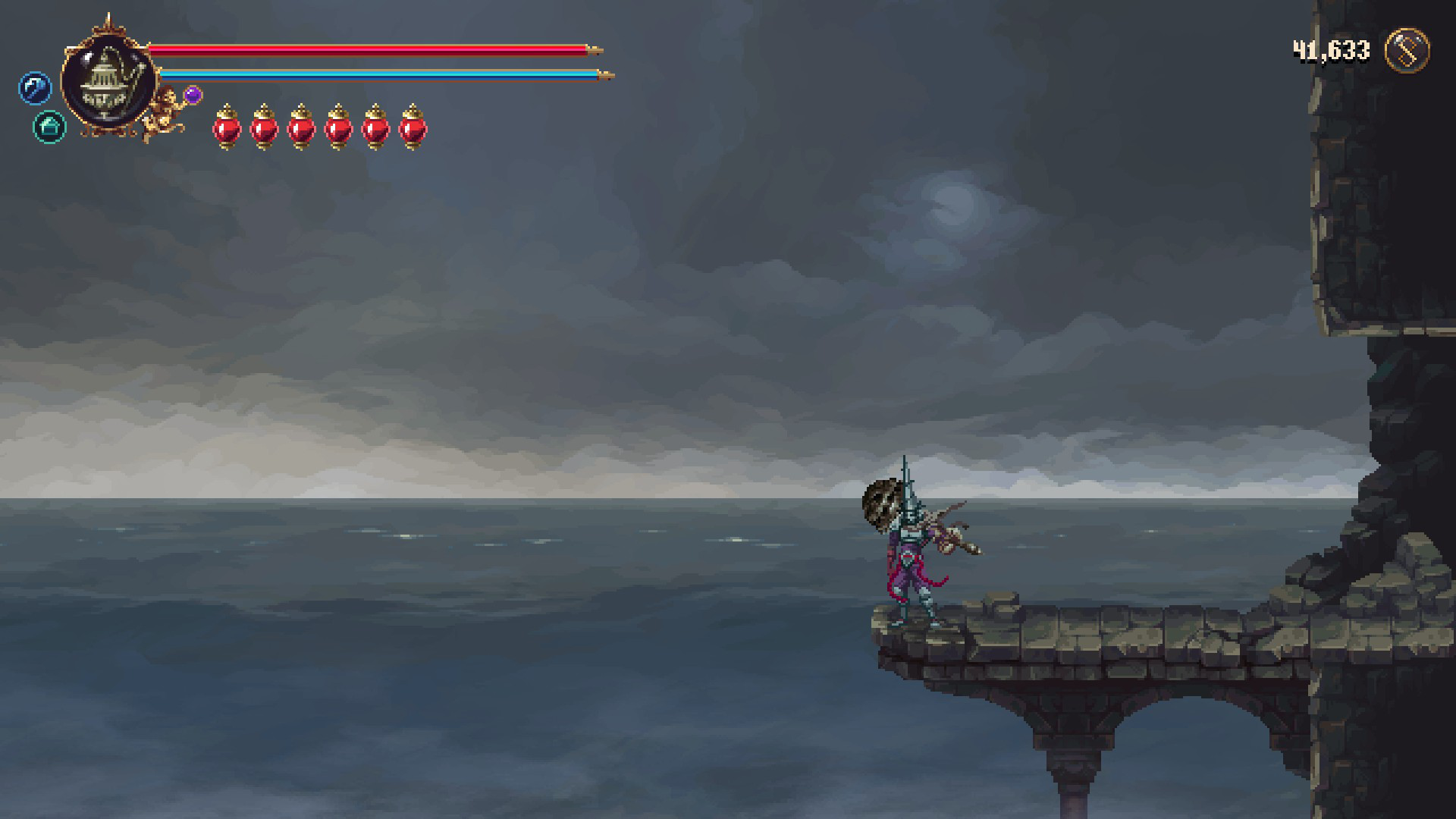
The final two were both quite good. One tasked you with finding a skull and walking beneath it, back and forth, a few times. There was only one place in the world map, and although it took me a moment to centre my brain on it, I had a glimmer of a memory of passing by a shopfront in the game’s main “town” area that had precisely such a symbol. Doing so indeed triggered the desired result – I thought this one was good precisely because the skull had stood out to me as being a little strange and out of place each time I walked past it (since the shop in question didn’t sell anything obvious morbid or deathly), but I still had to put in some serious thought to recall where it might be and what the clue might be talking about. Again, for this kind of riddle puzzle, I think that’s ideal – there’s a fine line in making sure it should be something the observant player has noticed, but without it being so obvious that nobody can miss it, and without it being so vague that even someone really soaking in the world is simply going to miss it and then have to look up which of the game’s five hundred rooms you’re supposed to visit. It was also, I think, a good idea to have this in the game’s hub, since it also boosts the extent to which the player will be going past it and over and over during play, and thus potentially remembering it. The final stage in the quest gave a hint about ending one’s life by jumping into the ocean, and that immediately reminded me of a mysterious room – which I’d specifically mentally noted first time around, since it seemed to have nothing in it – where a sort of pier or protrusion from a building’s wall simply ended above waves that killed the player when they fell into them. Again, a perfect example of setting something up for the savvy player to think “hmm, something’s strange in this room…” and commit it to memory, for use much later on. This one was much more effective than the unusual bell because it stood out so much more and couldn’t be mistaken (as it was for me) for just general variation, rather than something important. An entire room with “no purpose” is never going to have no purpose, but it would (in my view) be entirely reasonable for the bell to just be general decoration.
So, overall, I think there’s a lot of interesting stuff to learn here. Obviously, this is a quest style I’m leaning into heavily in URR. Challenging the player to observe or notice something, to remember things, to keep track of places of interest, to connect places of interest or particular actions to the obscure or cryptic things they’ve just been given information about, are all extremely compelling methods for this kind of thing. Yet, I think this quest highlights a lot of the challenges and problems with these as well. It matters what sequence the player encounters the thing to be interacted with, and the thing telling you how and when to interact with that thing. It matters how distinctive the thing to be interacted with is, and how that distinctiveness is conveyed. Are there loads of things which are comparable? Is it immediately clear to the player that something is different from all the other copies of that something? How close are the clue and the solution, and how close should they be? I’ve talked about this a lot on the blog, but cryptic riddle games (or games with cryptic riddle puzzles in them) are genuinely rare. There’s only a few dozen out there which I’d say exist in this category, and I’ve played a lot of them already. Making anything in this area is already a part of game design about which, ultimately, very little is actually known – and then making it all procedurally generated as well, for the first time ever, is the unknown terrain within the barely-charted terrain of the entire idea altogether. The point is, these are all really interesting, intriguing considerations, and ones that I’m really trying to factor into my own thinking. I want to tick a lot of the boxes that the good parts of these quests hit, but they also highlight a lot of the pitfalls and things to watch out for. I’m not sure what the solutions are yet, especially in such a vast world, and with generated riddles… but at least I’m thinking about it. A simpler reflection, finally, is that as a whole, the “I’ve left a trail for the smart person to find X” is just such a good framing for one of these quests – is it a person’s fortune, which they wanted to go to the clever seeker? Perhaps some precious weapon, new information that will point you towards new discoveries, a book of ancient secrets or maps of distant lands? It’s just such a good framing, and I think it’s one I’ll likely be using a lot in URR’s quest generator (which I will be posting about in the very near future!). So, yes: some interesting stuff here, I think, and some subtleties that really do matter.
Four Envoys Quest
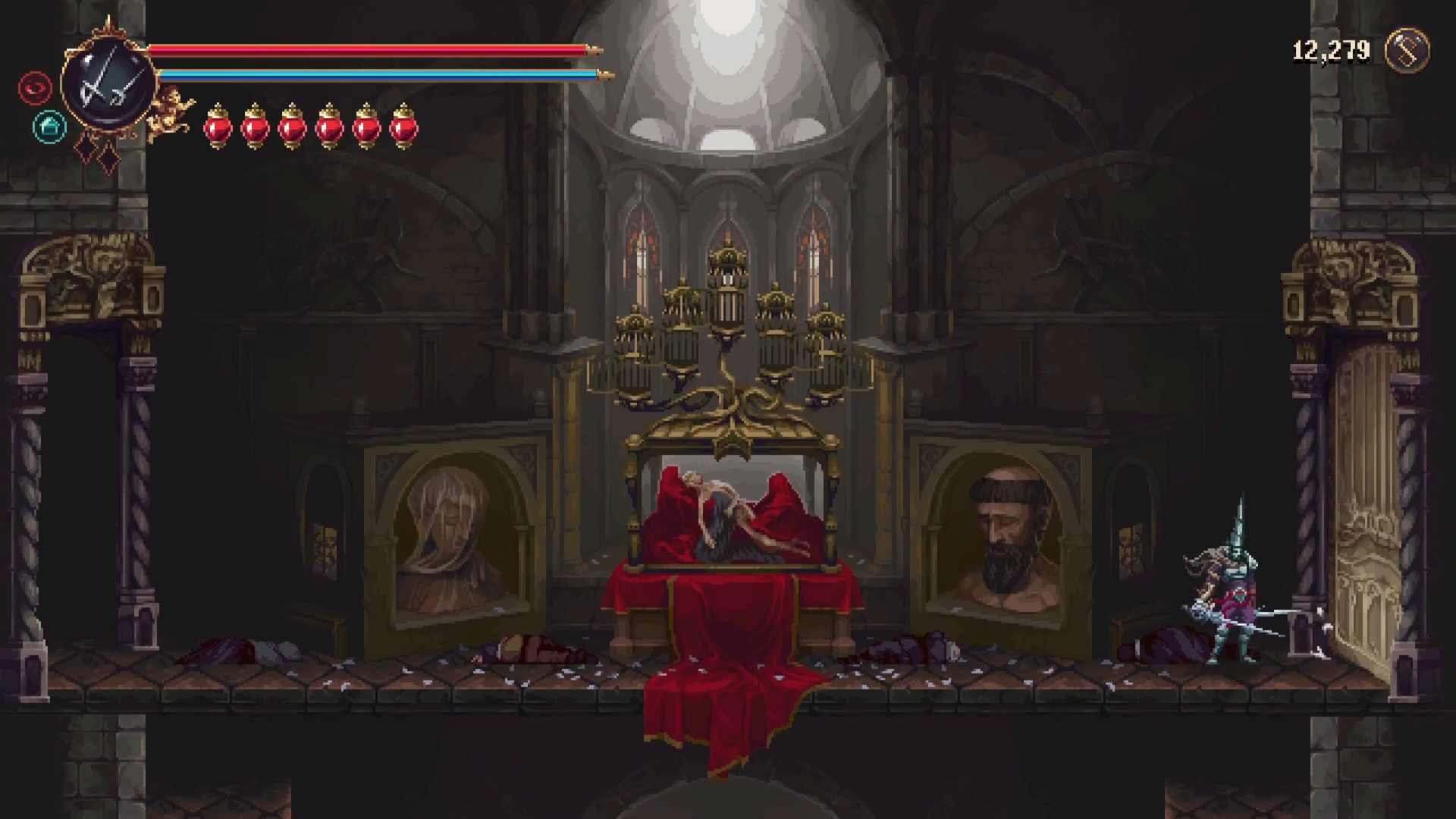
Finally, we come to this quest. It doesn’t have the issue that the third step of the cursed letter has, i.e. it’s referring to a room with no distinguishing features except a very obscure difference between a background item and other copies of that item, which the player won’t have thought about for 10+ hours by the time they get to this point; it doesn’t have the issues of the symbols quest that I explained at length above. For this quest, around the halfway point of the game the player gains access to a chapel containing two locked doors. On the left-hand side one is told to “Follow the heartbeats that herald the Birth”, and on the other side, one is told that “Four Envoys wrapped my body in soft linen cloths”. Progressing through the game results in the left-hand door being opened up anyway, as one defeats five bosses, each of which opens up one of the cages on the top of this altar to let a dove go free, and once they are all free, the door opens (such is the arcane logic of the Blasphemous world). That concludes the “follow the heartbeats” clue. The second door, however, remains stubbornly shut, offering only that written clue as explanation about what one is actually supposed to do here. I confess that it wasn’t until right at the very end of the game – once I was wondering what I’d missed in the game world – that I even seriously considered the possibility of being able to open this door. The trigger turned out to be really obscure, but very nicely and sensibly set up across the game, with in fact multiple things all gently hinting and pushing the player towards this conclusion. The intriguing thing, here, is that in a sense, the entire puzzle took place within my inventory, or rather one specific part of the inventory: the “altarpiece of favours” the player has which is filled with wooden statues that confer various stat benefits and advantages to your character.
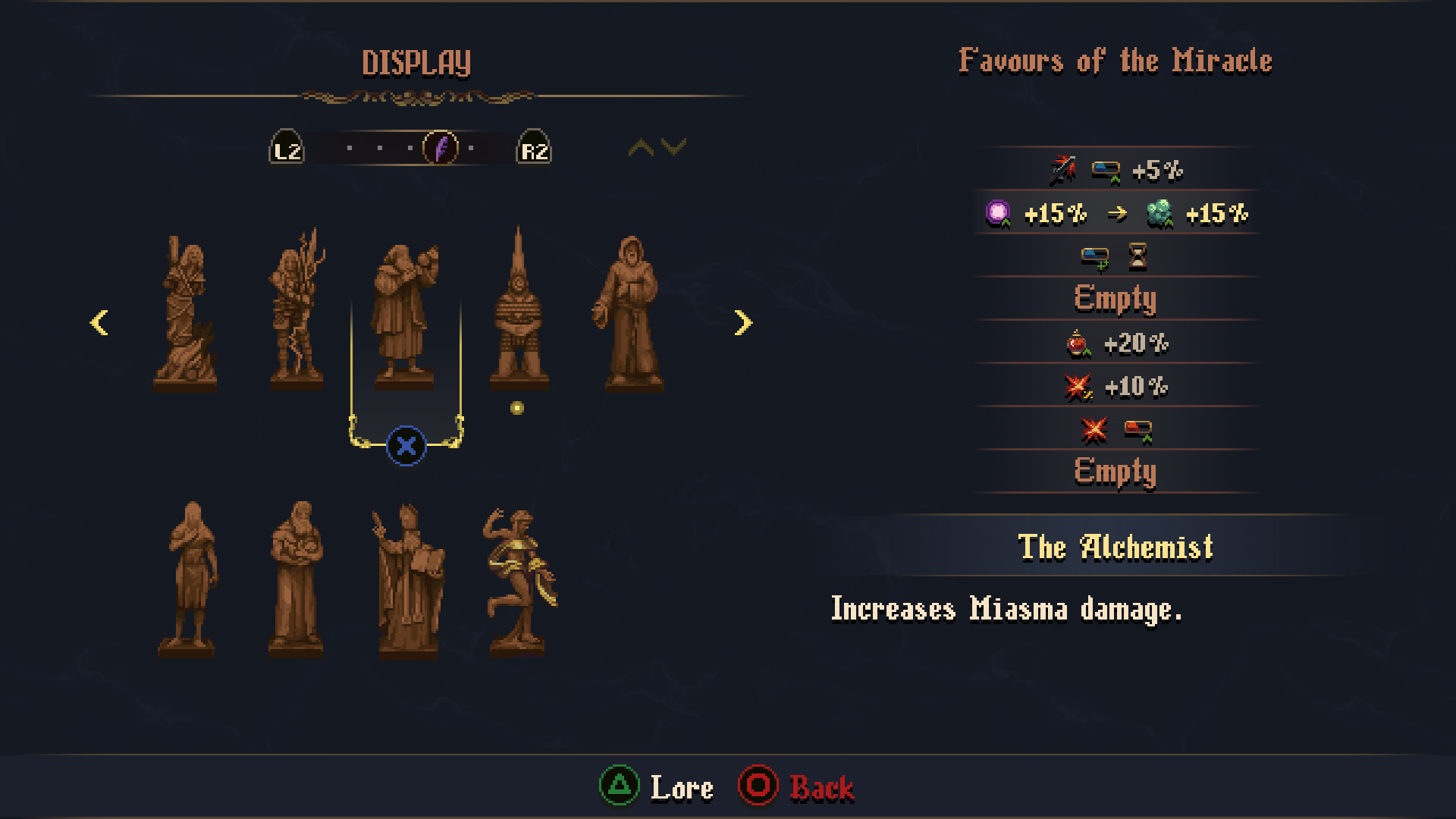
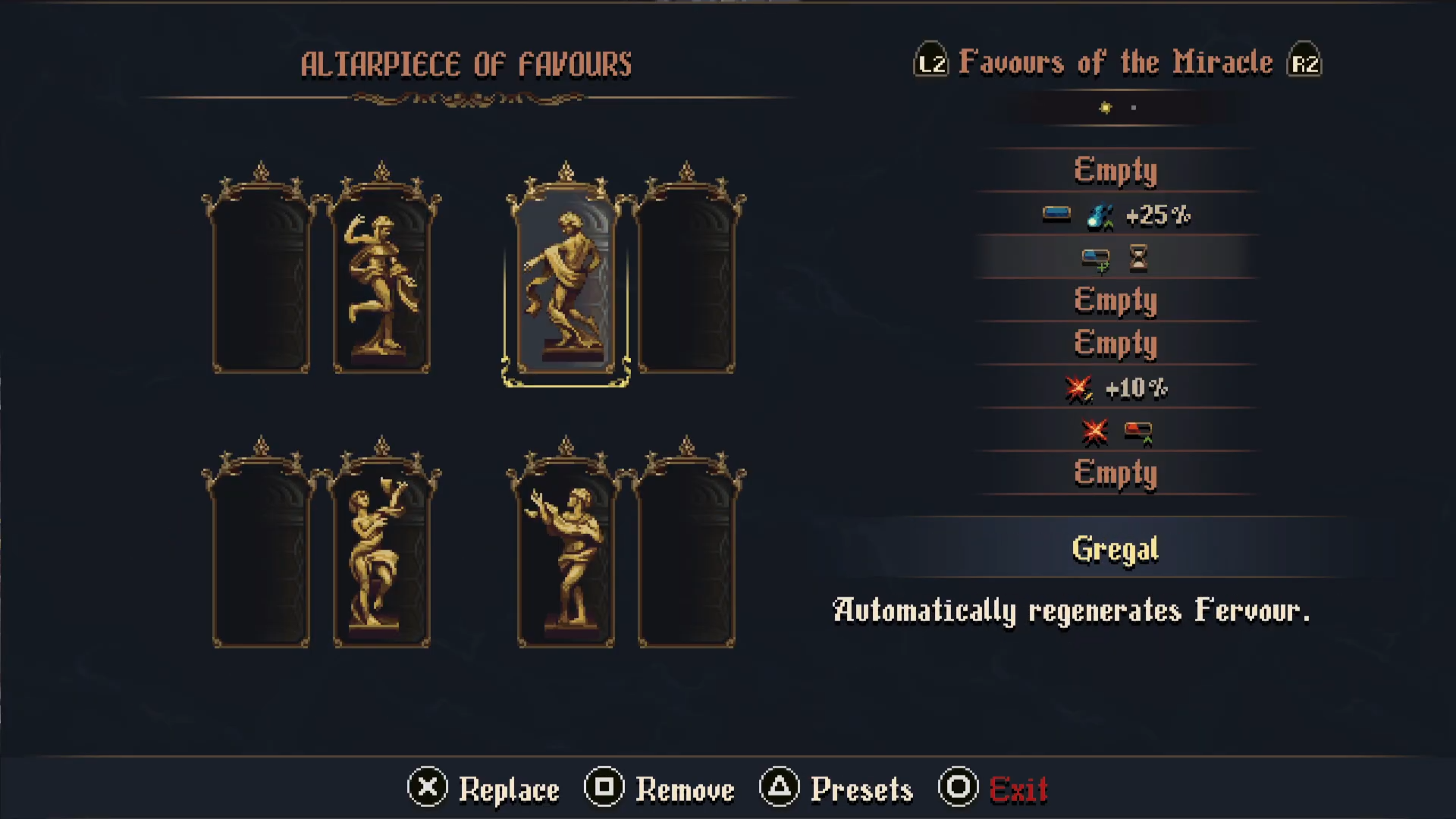
Most of the statues look similar, i.e. they are clearly made out of wood (at least, I think they are? Maybe they’re clay) and have a pose related to the name of the statue (“the hermit” or “the heretic” or whatever), but four of them – which you collect gradually across the game, in all kind of different places – are a bit different. See how that one statue has some gold cloth wrapped around themselves, and all the other statues have nothing of that sort? That’s not a coincidence, and there are exactly four such statues from the entire set which can be placed within the altarpiece. It turns out that when you place them in the altarpiece of favours in a way that enables the gold strands wrapping around them to line up logically – nothing in the game tells you to do this, keep in mind – you are able to use that to unlock a door which takes you towards a secret ending. The hint given to you listed above is an interesting hint because it suggests we should be doing something with NPCs, perhaps, or taking some kind of action within the game world to deal with these “envoys” and yield whatever one’s supposed to yield. By “hiding” the puzzle entirely within the inventory, though, there’s something really clever here. Of course other games have done things of this sort – I’m thinking about some of the Hideo Kojima stuff, which I haven’t really played, though I do remember that piece hiding in the inventory in P.T. – but it really is cunning to place something in here that relies on the player’s observation, and again, relies on the player’s inclination to experiment. The gold cloth wrapped around four of the statues could certainly just be a bit of decoration, but you might then notice that two of the cloths face in each direction, and then you have the little hint in the room… it is, again, very subtle indeed, but really does work very well. Much like some of the above, it relies on the idea that the game isn’t doing anything accidentally. Some of the tutorial messages in URR is actually specifically designed to try to get this point across, such as the museum tutorial (“A lot of information can be found in the appearance of things”) and the one that appears when you depart the starting university (“It will be hard to unravel [the world’s] secrets, but clues are hiding everywhere”) – but this one, again, is contingent on persuading the player that things matter and aren’t just set dressing, decoration, flavour text, or whatever else.
So: what can we learn from this one for URR? Well, I think the idea of having information in the items is a really interesting one. This is transparently the case for notes, of course, and will be the case for books, tablets and scrolls, but I think there are other more subtle ways to potentially get these sorts of inclusions. For instance, there might be information elsewhere that references particular colours or shapes in particular items, such as religious or national relics, but what I really wonder about is things entirely self-contained within the inventory. There are two potential models here – one would be encountering things which clearly denote that they need to be connected to something else, e.g. fragments of a map or fragments of some kind of item that clearly have other components the player hasn’t yet found. I think this one is good, and interesting, and I’d certainly like to get that kind of thing generating in the not-too-distant future. There’s good stuff to be done with those, especially in terms of pacing. Even more interesting, however, is this kind of cryptic puzzle, where there’s nothing explicit that denotes the relationship between a set of items or a hypothetical set of items (if one only has one of the final set of items), but one just has to notice it and figure out that there could be some kind of connection here. I’m not quite sure how this will work, but… I think the idea is tremendous. Perhaps a number of books on a subject, which might all be used for other quests, but which also contain an extra puzzle within that pages, somehow signaled or gestured to in subtle ways? Or, perhaps, etchings on instruments, or things hidden in jewellery, or fragments of information on keys, or… whatever it might be. I think this gives really rich terrain to explore – riddles within riddles! Riddles within things you’re otherwise using for other riddles – and will, like other things, continue to add more and more depth and detail into the game world, and maximising the chance of the player getting that first, all-important, “oh, wow” moment, when they realise how much is hidden in the game world. These will definitely require a bit more exploration, but this model absolutely has a lot of interesting potential.
Final Thoughts
Blasphemous II is a lot of fun, and I’ll be giving a review in my normal end-of-year review post (here’s last year’s), but I think it has some really interesting cryptic riddle type quests towards the end of the game. I don’t think any of these are absolutely perfect, but I think they all do exactly what you’re looking for in these types of puzzles – they’re largely relying on the player to notice that there even is something to solve, and then they’re promoting experimentation, lateral thinking, and observation and memory, to deduce what needs to be done. As I say, I don’t think these are perfect – the first one is absolutely bonkers unless it was intended to be a community-driven solution process rather than something an individual would solve themselves, but the second and third are very strong, even if I do think that the bell part of the second quest is wildly harder than the other four steps in the puzzle, and the invincible bell probably isn’t quite distinctive enough to stand out and be observed and registered by most players – even one who is obsessed with secret-based games and observation, like me! All of these, though, give valuable insights into really interesting things you can be set to decipher in a suitably complex world, and in a world where we should be able to generate vast numbers of these, each with different clues, different solves, different information, different paths, different required actions, wrapped in the cryptic cloth of riddles and rhymes and obscure maps… well, that seems entirely delightful to me. But what these examples really show me is that it’s hard enough to make cryptic riddle quests that are enjoyable, logical, compelling, and cryptic without being ambiguous, in games with solely handmade content, but in a procedural generation game? What on earth have I bitten off? Still – I’m confident I can make it work (and indeed, I am making it work as we speak, with generated rhyming riddles now fully implemented into the game, and (essentially) playable!). I continue to seek out these sorts of games, looking always to try to find “types” of cryptic riddle which can be abstracted, and then generated – as there’s just so much novel gameplay to be yielded by generating these sorts of challenges for the first time (especially since nobody can just go and use a guide!). I think that’s all for this week though, friends – as ever, please do let me know your thoughts, and I’ll see you all in a fortnight for another usual dev update :).
I couldn’t even spot some of those hidden symbols in the Blasphemous II screenshots! But the cursed letter quest is much more clever and fun.
Regarding URR, it’s interesting that due to the procedural-generated nature of the clues URR will never have “community puzzles”, but it can have “community solutions” in which more experienced players might publish guides on how to interpret visual or textual clues. I think there’s also a lot of potential for community interaction with users posting clues online that have stumped them, and then other users can offer their own interpretations and suggestions.
Thank you crowbar! Yeah, the symbols are bonkers in some cases – again, I think there’s potential in a quest *like* that, but it has to be actually doable by one person and something which has, perhaps, other paths into it beyond just “look through 600 screens and try and see almost invisible things”. It’s so interesting design-wise though, as the abstract concept of the quest is so compelling, yet the gameplay so tricky to make interesting. Perhaps the solution is to give the player the quest BEFORE they might see any of these things, so they’re things to keep an eye out for, and – in such a big world – have more than the minimum required? That, actually, could work…
And – yes! You have described, beautifully, exactly where I hope to be in a couple of years. That would be incredibly awesome and interesting and I *really* do hope we get there.
Hi Mark,
I’m not going to pretend I read every dev log, but I certainly like stuff like this and your end-of-year lists. The whole piece was good; I have a couple concrete points:
1. A few things touched on this (“this room can’t truly have no purpose”/“I was about to give up on this door”) – how do you feel about that one door in Hollow Knight that can’t be opened? I expect you hate it, but I’m curious if you have further/other thoughts.
2. Kind of related to the above, but your “nothing is there accidentally” has to actually hold within a game, which is easier said than done, especially when you’re also hiding a needle in a haystack. I’m sure you’re keeping this in mind for URR.
3. While I don’t think it’s necessarily good to give players a “new puzzle generator” on demand, I think it’s important for players to have some number of threads they can chase down in parallel. Outer Wilds did this very well, La-Mulana did sometimes and not others. The Witness kind of did it well (despite its other flaws), but it was mostly “go take a break in a different area with different puzzles”, not “another piece of a big cryptic one”. Oh, and Case of the Golden Idol and Return of the Obra Dinn also did it well.
One unrelated note that I just thought of: in a dev blog a while ago, you talked about how combination locks are brute-forceable once you have all but one part of the combo, which is frustrating. You may have already come up with a solution, but if not: can you just turn a 3-dial lock into a 9-dial lock, and the three clues give three dials each? (The clues wouldn’t have to be for adjacent dials, but that’s aesthetic, not gameplay, unless you also make it unclear which dial the clue is about.) It’s *slightly* clunky, but also somewhat elegant and diegetic, since the in-world creator wouldn’t want it brute-forced either.
Hello Henry! Thanks so much for this really detailed comment, I very much appreciate it.
1) Ha! I think there’s some intending storytelling element there, is there not? I forget (it has been a while). Overall, yeah, I think it does break the rule of encouraging the observant player to observe and draw conclusions about places to return to. If there were many such doors then that could be an intentional thing, i.e. deciphering real doors is somehow integrated into gameplay, but with just one… yeah, probably not a fan.
2) I am definitely keeping it in mind – and it’s tough enough in a game with nothing but handmade areas / riddles etc, let alone a PCG equivalent. I am confident that playtesting and/or the 0.11 release will find players latching onto as important things which are not important, and that’ll be something to refine and address. It’s actually a classic issue in cryptic riddle games, and one I’ve experienced myself, where I see something in the game world and think it must be important, and it stays in my brain for hour after hour… and in the end is just a bit of decoration. So, yeah – it’s a complex thing and something I’ll be watching closely.
3) Yes, agreed! I don’t want things to forced through one required quest. I actually think La-Mulana 1 does this incredibly, the number of paths you can take to advance through the game, with the exception of really one chokepoint (the gates puzzle in the Endless Corridor) is astounding, even by Metroidvania standards. Agreed also re: RotOD, though haven’t played CotGI yet – though I do intend to. But, yes, I agree, we’ve got to have multiple ways to advance at any given moment. This adds complexity to the quest generator, of course, but that’s okay, I’m up for it!
And thank you for this idea! That’s definitely possible. I *think* I’m just going to have them not give clues which only give part of the dials – or only do so if the door/chest is boobytrapped and thus the player is allowed to take a 1/10 or 1/15 chance if they so wish – but that’s absolutely another solution too! I’ll keep giving it some thought.